1. Introduction
Adaptive reuse of buildings is becoming increasingly popular, and architectural specialists predict that in the future fewer buildings will be built and more will be reused. In general, adaptive reuse may be defined as a process by which an unused or ineffective item is turned into a new one that will be used for another purpose; thus, it is a form of recycling
| [14] | Dormakaba (07/23/2020) “Adaptive Reuse: Paving the way for a more sustainable construction industry”. Dormakaba editorial team (blog. Dormakaba.com adaptive reuse). Consulted: Oct 15, 2021. |
[14]
. Such reuse in architecture involves use of abandoned structures for purposes other than those for which they were originally intended.
Adaptative reuse results from a need to minimize waste on construction sites, and involves reusing parts of the original building, which results in saving energy upon producing construction materials - one of the most energy-intensive and highly polluting industries. While heritage buildings have traditionally been preserved through restoration, rehabilitation, and reuse, some architects and engineers without proper training in preservation of this heritage attempt to modify the form and function of historic buildings upon recycling them, often resulting in destruction of heritage. This raises the question as to what extent these professionals should exercise such architectural freedom.
We should ask who is promoting adaptive reuse. Perhaps the trend of reusing heritage involves taking advantage of the global environmental crisis to be able to establish less stringent heritage preservation laws, thereby placing this heritage – and even the population - at risk if architects without adequate training intervene. While those promoting ecological construction reject use of metals, concrete, large windows that allow heat to escape in cold climates, and excessive reliance on artificial heating and cooling systems, adaptive reuse often uses these materials and construction techniques. Therefore, is adaptive reuse really intended as ecological architecture?
Determining the true objectives of adaptive reuse requires taking into account economic changes promoted by capitalism in recent decades, which in turn have led to significant cultural changes. This article hypothesizes that ways of intervening into cultural heritage will be modified as economic relations – and in turn public policy - are transformed within capitalism. The future existence of the discipline of adaptive reuse will depend on social and economic conditions, which we expect will support this approach to intervening into historic heritage architecture. Nevertheless, we consider that the traditional disciplines of restoration and rehabilitation - as well as pre-existing forms of reuse - will continue to prevail in cultural heritage preservation, increasingly adapting to changing global ecological demands as well as to social changes. In order to determine the viability of this hypothesis, there is a need to identify the interests that underlie adaptive reuse.
For this, it is necessary to comprehend the phenomenon of cultural heritage as part of the current cultural context which is strongly influenced by neoliberal globalization
| [22] | Rojas, M. (2015) Dialectics of Heritage. Mexico City: UAM del lirio Ed. |
[22]
- understood to be a current capitalist weapon in synergy with the fundamental pillars of modernity: the State, science, and cultural identity
| [2] | Brunner, J. J. (2002) Cultural Globalization and Postmodernity. Santiago de Chile: F. C. E. |
[2]
. In turn, modernity may be regarded as “a project of integrative, liberating rationality”, while modernization is rather “an instrumental economic reductionism of modern rationality”
| [22] | Rojas, M. (2015) Dialectics of Heritage. Mexico City: UAM del lirio Ed. |
[22]
.
Just as a conflict exists between modernity and modernism, a conflict also exists between culture and globalization with respect to people´s identity and cultural heritage. Nevertheless, globalization of popular culture - consisting of widespread adoption of cultural manifestations and consumer habits of so-called “developed” nations (known in Spanish-speaking countries as mundialización) - appears to have spread throughout the world as never before, particularly in the transnational cultural industry of tourism. Adaptive reuse emerges in the context of confrontation between global economic interests and local social movements.
The concept of adaptive reuse has gone from addressing only national heritage to also including local and global heritage, in turn broadening the promoters of heritage to include nations – particularly those with a nationalist tendency, as well as UNESCO, civil society, and private businesses such as those involved in tourism and advertising. Tourism has become, one of the world´s largest and fastest growing economic sectors, with the number of tourists having increased from 25 million in 1950 to an estimated 1.6 billion in 2020
| [1] | Bandarin, F. & Van Oers, R. (2014) The Historic Urban Landscape: Heritage Management in an Urban Century. Madrid: Abada Ed. |
[1]
, and 1.5 billion in 2023
| [19] | Orús, A. (16/oct/2024) “Tourism in the world. Statistical data”. es.statista.com Consulted: May 4, 2025. |
[19]
due to the Covid 19 crisis. Therefore, it is necessary to consider the socioeconomic impact of the growth of tourism on each nation and specific locality, as well as its effects on cultural heritage.
The objective of this article is to contribute to understanding the following:
1) The origin of traditional reuse, “politica del riuso”, and adaptive reuse in architecture;
2) The place of adaptive reuse and traditional reuse in those disciplines of restoration that have traditionally addressed conservation of historical cultural heritage; and
3) The place of adaptive reuse within the current global economic and social context.
The concept of reuse in architecture – known as “
política del riuso”, or “policy of reuse” - originated in Italy as a consequence of urban struggles of the late 1960s, principally regarding access to housing, following intervention into the historic center of Bologna to preserve historic architecture while promoting social well-being. This intervention is considered to be the paradigm of protection of historic centers, despite the fact that its initial objectives – including providing housing to those most in need by expropriating large-scale properties - were not achieved. By contrast, during the 1960s in France, the United States, and other nations, “urban renewal” had generally involved speculative or “perverse” use of heritage, resulting in marginalization of some social groups. During that decade, activists including Jane Jacobs fought tirelessly against such marginalization. In line with this movement, leftist Italian conservation specialists developed an ideological-political position regarding the manner in which intervention into heritage buildings should be conceived based on the “policy of reuse” and the concept of holistic conservation, rooted in what we refer to as “traditional” reuse, which humans have carried out since they first built permanent constructions, consisting of modifying their original use which was is longer functional. This new approach was based on the following principles
| [11] | Dezzi, Bardeschi, M. (1981) “Limits and ways of conservation”. In Building reuse and redevelopment in the 1980s. Milan: Franco Angeli Ed. |
[11]
.
1) Reuse involves an already existing object, structure, or material context (building, city, territory), and prioritizes use of built structures (use value) over the construction itself (material value).
2) Housing deficits may be reduced through reuse or recovery of existing residential structures along with provision of necessary public services, prioritizing public over private use of historic buildings and other spaces, with the objective that historically marginalized urban classes collectively appropriate use of urban spaces.
3) Reuse involves functional recovery of architecture that has lost its use value due to economic fluctuations that have made existing constructions incompatible with new forms of use.
4) Reuse allows for limiting or even detaining urban growth, and for a critical reinterpretation of the modernist conception of “new” architecture, which is designed to quickly replace everything that exists.
4. Results and Discussions
Reuse Throughout the History of Humanity
Architectural restoration and reuse have been practiced throughout the history of humanity, with an emphasis on one or the other according to the dominant values of society at the time.
In order to comprehend the historical role of reuse in architecture, it is important to consider the perspective of Valerio di Battista (1995) regarding the origin of the discipline of traditional architectural reuse. According to this author, reuse is evident in the history of human-built constructions, as human settlements have been used by a number of generations for different purposes, and it is precisely the continuity or destruction of such settlements - including their buildings and associated values - that has determined the permanence or decline and disappearance of ethnicities and cultures
| [12] | Di Battista, V. (1995) “Reuse: case studies, problems, potential”. In Battista, V.; Fontana, C.; Pinto, M. R. Flexibility and reuse. Florence, Italy: Alinea Ed. |
[12]
.
As occurs during periods of war, famine, and epidemics - and as movements in defense of the poorest population groups have promoted, upon reuse the value of old structures as resources prevails over their symbolic value. This has occurred with religious structures, transforming pagan temples into Christian basilicas or building churches on the sites of Roman baths
| [12] | Di Battista, V. (1995) “Reuse: case studies, problems, potential”. In Battista, V.; Fontana, C.; Pinto, M. R. Flexibility and reuse. Florence, Italy: Alinea Ed. |
[12]
. At certain points in history, built heritage has been simultaneously valued as a resource as well as for its symbolic value, although at times one or the other has prevailed.
According to Isabel Nieto (2022), reflexive consciousness regarding temporality began to arise during the Renaissance. “For the first time, a distinction was made among styles, based on analysis of many factors: form, […] structure, the relationship with the divine, [and] the wealth that the construction represents”
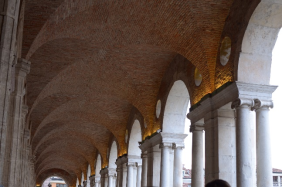
. These new Renaissance architects negatively qualified certain stages of history - such as the Middle Ages, and positively qualified others - such as the Classical period. This is evidenced by Palladio`s intervention into the Basilica of Vicenza. As did other Renaissance architects upon renovating ancient buildings – including Alberti (1404-1472) upon renovating churches in Florence and Rimini - Palladio ignored the medieval form of the building`s frame, covering it with classically-inspired arches and columns that covered two stories
(
Figure 1). Many other Renaissance architectural works involved reuse, including the Roman Basilica of Santa María degli Angeli within the Diocletian Thermal Building under the charge of Michelangelo. Furthermore, many renowned Renaissance architects made proposals to complete the facades of medieval churches, which were never implemented. Carlo Ceschi (1970) presents many examples of such unimplemented proposals in his text
Teoria e storia del Restauro | [9] | Ceschi, C. (1970) Theory and history of restoration. Rome: Mario Bulzoni Ed. |
[9]
.
Figure 1. Image of the Basilica di Vicenza - a mid-15th century Gothic building of Vicenza, Italy - which incorporated the classical Palladian architectural style in 1549.
While Renaissance artists admired classical works, copied them, and were inspired by them for their creations, they were indifferent to their destruction, and some even promoted substituting ancient buildings with their own works
| [9] | Ceschi, C. (1970) Theory and history of restoration. Rome: Mario Bulzoni Ed. |
[9]
.
In the absence of a historical vision of the past, the relationship man - work of art is always imprecise, mutable, [and] arbitrary, and when architects approach a monument to adapt it to new demands, substitute a part of it, or complete it, the monument should always [dominate] the vision of the architect and never vice versa.
| [9] | Ceschi, C. (1970) Theory and history of restoration. Rome: Mario Bulzoni Ed. |
[9]
Thus, Renaissance artists did not adopt conservationist criteria; rather, superposition, substitution, and occasionally integration or finishings were the norm. While this era was characterized by broad acceptance of reuse of historic buildings and of construction materials from such buildings, after the Renaissance preservation of heritage was not of interest until the XIX century, despite great interest in archeology in the XVIII century due to the discovery of classical cities, until then hidden.
The Origin of Conservation of Monuments and the Birth of Restoration
Concern for conserving heritage buildings dates to the early XVIII century, when interest in classical architecture was growing. During this time, the work of the Italian architect Vitruvio became popular; classical cities including Herculaneum and Pompei were discovered; significant excavations were carried out in Rome, Sicily, and Pompei; and archeology began to be considered a science, leading to creation of the neoclassical architectural style. Growing interest in classical art led to development of renowned private collections, such as that of the Vatican. In the midst of this artistic climate, Prussian historian Johann Joachim Winckelmann who had arrived in Rome in 1755 was asked to organize and classify the Vatican´s Greek and Roman art collections, and his resulting knowledge and appreciation of Classical art greatly contributed to the budding science of archeology
| [9] | Ceschi, C. (1970) Theory and history of restoration. Rome: Mario Bulzoni Ed. |
[9]
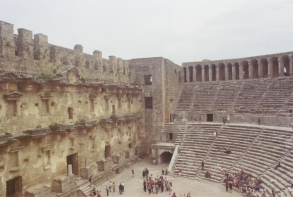
. This attention to classical art led to growing interest in Greek and Roman architecture, and in turn to interest in its conservation (
Figure 2).
Figure 2. The Aspendos Theater in Turkey, which is a classic example of Roman architecture. Interest in such classical architecture was the predecessor of architectural restoration.
The French Revolution brought about government intervention “into private property, considering it to be public property of a cultural nature - therefore belonging to all citizens of the Republic. [Such government intervention] would lay the foundations of what today is considered modern heritage”
| [22] | Rojas, M. (2015) Dialectics of Heritage. Mexico City: UAM del lirio Ed. |
[22]
.
Upon storming the Bastille on July 14 of 1789, the popular revolution identified palaces, villas, and castles as a testimony of the tyranny of the preceding monastic dynasty, effectively establishing a secular religion characterized by a “regimen of reason” that suppressed churches and convents
| [9] | Ceschi, C. (1970) Theory and history of restoration. Rome: Mario Bulzoni Ed. |
[9]
. Françoise Choay (1992)
| [10] | Choay, F. (2007) Allegory of heritage. Barcelona: Gustavo Gili Ed. |
[10]
comments that one of the first revolutionary acts of post-revolutionary France`s Constituent Assembly – on October 2 of 1789 - was to place property of the church, the crown, and emigres at the disposition of the nation, thus prioritizing the exchange value of antiquities - that is the nation`s primordial economic heritage - under the argument that they were possessions that had to be preserved and maintained “to avoid the risk of financial loss”. After overcoming a series of political-economic difficulties, the French revolutionary government classified heritage antiquities into moveable heritage (artwork, furniture) and immoveable heritage (buildings). Movable heritage was sent to a permanent storage which was open to the public – later referred to as a “museum” - with the function of contributing to the education of a nation, providing lessons on citizenship, history, and artistic trades and techniques. With respect to immovable heritage, new uses had to be invented for buildings that had lost their original function. For example, questions arose as what to do with churches. One suggestion was that they systematically be used as museums, and those which had lost their ceiling were eventually converted into markets or storage for ammunition, saltpeter, or salt, while convents and abbeys were transformed into jails or barracks
| [10] | Choay, F. (2007) Allegory of heritage. Barcelona: Gustavo Gili Ed. |
[10]
.
In response to these initial proposals aimed at protecting heritage, a series of vandalistic positions arose seeking to destroy all remaining pre-war heritage given that it had belonged to the now-defeated upper class. This position contrasted with those of the Comité d’Instruction Publique and the Commisions des Arts, which sought to protect this heritage, and which were supported by those advocating conservation of historic heritage who proposed the concept of national value.
Finally, as a result of the revolutionary impulse of 1789, “all the elements required for an authentic policy of conservation of historic heritage appeared to have been assembled: creation of the term historic monument […]; corpus in the process of being inventoried; and presence of an administration charged with its conservation that has access to unprecedented legal and technical mechanisms (including penal provisions)”
| [10] | Choay, F. (2007) Allegory of heritage. Barcelona: Gustavo Gili Ed. |
[10]
.
In 1820, the first organized approach to restoration of monuments was implemented. Ludovico Vitét became the first French general inspector of historic monuments in 1837, followed by Prosper Merimée who was assisted by the architect Eugenio Emmanuele Violet le Duc to carry out the task of reconstructing heritage damaged during the French Revolution
| [9] | Ceschi, C. (1970) Theory and history of restoration. Rome: Mario Bulzoni Ed. |
[9]
. This reconstruction had unfortunate consequences, as a result of le Duc`s students who lacked his knowledge and abilities and failed to comprehend his philosophy regarding intervention into damaged monuments.
According to le Duc, the architect should approach a building with deep humility, depersonalizing himself – that is, prioritizing the taste and artistic temperament of the artist who originally executed the work over his personal considerations (
Figure 4). Nevertheless, it has been argued that more historical heritage was destroyed as a result of this theoretical position of French architects than by the Revolution itself
| [9] | Ceschi, C. (1970) Theory and history of restoration. Rome: Mario Bulzoni Ed. |
[9]
.
The great XIX century English art critic John Ruskin lashed out against le Duc with his position that monuments in decay should not be restored, rather assuming a contemplative position.
The work of art, and therefore the monument, is a creation that belongs only to its creator; we may enjoy it, experience its decay, admire its ruin, but we do not have the right to touch it because it does not belong to us.
| [24] | Ruskin, J. (2018) The seven lamps of architecture by John Ruskin. Amazon. |
| [9] | Ceschi, C. (1970) Theory and history of restoration. Rome: Mario Bulzoni Ed. |
[24, 9]
The ideas of Ruskin enriched the concept of historic monuments by including domestic architecture and “urban complexes”, which were previously disdained. According to Ruskin, regardless of the civilization or social group that constructed a monument, it belongs equally to all of society
| [10] | Choay, F. (2007) Allegory of heritage. Barcelona: Gustavo Gili Ed. |
[10]
. “Upon reconciling the sacred dimension of the human endeavor with the effective memory, the historic monument furthermore acquires unprecedented universality. Thus, Ruskin and William Morris may be considered to be the first to conceive of protection of historic monuments on an international scale
| [10] | Choay, F. (2007) Allegory of heritage. Barcelona: Gustavo Gili Ed. |
[10]
.
The Industrial Revolution resulted in social and material degradation of urban contexts, which contributed to modifying the hierarchy of values attributed to historic monuments; for the first time, values related to sensitivity - particularly aesthetics - were prioritized. From the 1850s on, historic monuments were venerated by the majority of European nations
| [10] | Choay, F. (2007) Allegory of heritage. Barcelona: Gustavo Gili Ed. |
[10]
.
Many large European cities were modernized, principally under the argument of fomenting hygiene in poorer neighborhoods. However, behind these efforts were speculative interests, as illustrated by the “modernization” efforts of engineer Georges-Eugène Haussmann in historic Paris, which influenced other European cities
| [10] | Choay, F. (2007) Allegory of heritage. Barcelona: Gustavo Gili Ed. |
[10]
. Furthermore, under the guise of “fixing up” neighborhoods to improve public health, European governments created large avenues designed to facilitate mobilization of their armies in the event of popular revolts.
While England was the cradle of the Industrial Revolution, it continued to be closely bound to its traditions, and the English public in general continued to involve their historic monuments in their daily life. According to Choay
| [10] | Choay, F. (2007) Allegory of heritage. Barcelona: Gustavo Gili Ed. |
[10]
, for the British, “monuments of the past are necessary for life in the present, not as decorations nor as archaisms, not only as bearers of knowledge and pleasure, but rather as part of daily life”. Thus, it may be inferred that the English never lost sight of the use value of their heritage.
The artistic movement that some authors refer to as cultural urbanism, characterized by the romanticism of XIX century England, was founded by John Ruskin and William Morris, and promoted by Viennese architect and historian Camillo Sitte (1843-1903) who considered that policies and architectural practices of the times were destroying many historic European urban centers. His master work,
Construcción de ciudades según principios artísticos (Construction of cities according to artistic principles) (1890)
| [25] | Sitte, C. (1980) Construction of cities according to artistic principles. In Collins, G. and Collins C. (1980) Camillo Sitte and the Birth of Modern Urbanism. Barcelona: Gustavo Gili Ed. |
[25]
, analyzed the components of ancient and medieval cities to illustrate how historic monuments are integrated into their environment. Sitte insisted on the importance of the use value of heritage, above all with respect to classical and medieval architecture.
An important contribution of Ruskin and Morris was that they were the first to conceive of an international organization to protect historic monuments. In 1854, Ruskin proposed the creation of such an organization for Europe, which its member nations would provide with technical and financial support, and promoted the notion of European cultural assets
| [10] | Choay, F. (2007) Allegory of heritage. Barcelona: Gustavo Gili Ed. |
[10]
. However, from a romantic position contrary to that of le Duc, Ruskin rejected restoration of historic monuments, possibly due to the fact that restoration prioritized use value over symbolic value. Thus, Ruskin saw restoration as absolute destruction of a building, stating, “it is no more than a lie from beginning to end”. He considered restoration to be not only absurd, but also impossible, akin to reviving the dead
| [24] | Ruskin, J. (2018) The seven lamps of architecture by John Ruskin. Amazon. |
| [10] | Choay, F. (2007) Allegory of heritage. Barcelona: Gustavo Gili Ed. |
[24, 10]
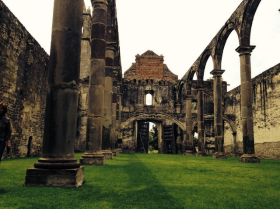
. In short, the concept of conservation of historic buildings ranged from “destructive” restoration, as perceived in France, to doing nothing, as was the vision in England (
Figure 3).
Figure 3. Photograph of the Tecalli de Herrera Cathedral in Puebla, Mexico, which was “restored” according to the principles of Ruskin.
In 1879, Italian architect Camillo Boito expressed an intermediate position between the fatalist perspective of Ruskin that was coming into fashion and le Duc´s position that was becoming outmoded. Reacting against Ruskin, he refused to accept the death of a monument, just as one does not accept a human death without first having attempted all measures to save the person. He condemned le Duc for having led restorers along the path of falsification and lies by presuming to know how the original architect would have restored it
| [9] | Ceschi, C. (1970) Theory and history of restoration. Rome: Mario Bulzoni Ed. |
[9]
. Boito proposed the following eight basic principles of restoration, that in 1883 became an internationally recognized restoration charter
| [9] | Ceschi, C. (1970) Theory and history of restoration. Rome: Mario Bulzoni Ed. |
[9]
:
1) Differentiation in style between new and old parts of a building
2) Distinction between original and new architectural materials
3) Elimination of moldings and decorative elements which have been added since the original construction but are not true to the original design
4) Nearby exhibition of parts of a historic building removed during restoration
5) Inscription of date of restoration on new material in a historic building
6) Descriptive epigraph of restoration work attached to the monument
7) Description and photographs of phases of restoration on or near the monument, and/or publication of this material in newspapers
8) National and international publicity of restoration work carried out.
In 1909, these guidelines were integrated into Italian legislation, which conceived conservation of historic monuments – as influenced by Ruskin and Morris – as being based on the notion of authenticity, or being true to the original work. This charter establishes that even the patina of old buildings should be preserved, as well as any successive modifications, which le Duc condemned. Supporting le Duc over Ruskin and Morris, Boito prioritized the present over the past, and defended the legitimacy of restoration
| [10] | Choay, F. (2007) Allegory of heritage. Barcelona: Gustavo Gili Ed. |
[10]
. Based on Boito´s proposal, restoration became the principal trend in conservation of historic monuments.
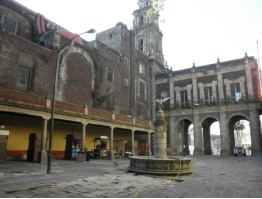
In the mid-20th century, Boito´s most outstanding student, Gustavo Giovannoni, promoted concern for the monument’s site or surrounding context. Both Giovannoni and Boito made efforts to share their experience regarding heritage outside of Italy, and over time criteria for conservation of historic monuments began to be developed in other European countries aside from France, England, and Italy. Giovannoni was the first to be concerned with conserving the environment surrounding monuments, and with him restoration architects began to pay attention to the concepts of urban environments and historic cities (
Figure 4).
Figure 4. The Santo Domingo church of Mexico City, restored following guidelines developed by Italian architect Gustavo Giovannoni, who considered the surroundings of monuments.
In the early XX century, Viennese art historian Alois Riegl attempted to differentiate the concept of “historic monument” from that of a simple “monument”. He described the former as “commemorative”, being linked to the past and to history, and having a value “of antiquity”. Meanwhile, he described simple monuments as artistic heritage which is “contemporary”, belonging to the present, and which has an artistic value as well as a practical “use value”. Reigl distinguished the “relative value of art”, in reference to antique works of art that continue to be accessible to modern sensibility, from the “value of that which is new”, in reference to the fresh, intact appearance of more recent works
| [10] | Choay, F. (2007) Allegory of heritage. Barcelona: Gustavo Gili Ed. |
[10]
.
Following this approach, Riegl established which monuments should be conserved and which should be reused. Riegl defined monument in the following manner:
In the oldest and most original sense, a monument is a work of man erected for the specific purpose of keeping particular human deeds or destinies (or a complex accumulation thereof) alive and present in the consciousness of future generations.
In line with this definition, Riegl made an initial attempt to “catalogue” monuments according to their cultural value. He argued that the lesser the alteration of a monument from its original state, the greater its historic value
.
In 1964, the Second International Congress of Architects and Technicians of Historical Monuments was held in Venice. The introduction of the resulting document which came to be known as the Venice Charter established the following concept of heritage:
The historic monuments of generations of people remain to the present day as living witnesses of their age-old traditions. People are becoming more and more conscious of the unity of human values and regard ancient monuments as common heritage. The common responsibility to safeguard them for future generations is recognized. It is our duty to hand them on in the full richness of their authenticity.
| [17] | ICOMOS (1964) “The Venice Charter”. admin.icomos.org Consulted: May 11, 2025. |
[17]
The Venice Charter furthermore established the following definition of historic monument:
The concept of a historic monument embraces not only the single architectural work but also the urban or rural setting in which the evidence of a particular civilization, a significant development or a historic event is found. This applies not only to great works of art but also to more modest works of the past which have acquired cultural significance with the passing of time.
| [17] | ICOMOS (1964) “The Venice Charter”. admin.icomos.org Consulted: May 11, 2025. |
[17]
Thus, the Venice Charter emphasizes the importance of conservation and restoration of monuments, as well as conservation and protection of monumental sites (historic complexes).
The Modern Architectural Movement and Symbolic Value
The Modern Movement, also known as Rationalism, predominated in the 1920s-60s. This movement values “the remains of the past exclusively based on their symbolic value”
| [12] | Di Battista, V. (1995) “Reuse: case studies, problems, potential”. In Battista, V.; Fontana, C.; Pinto, M. R. Flexibility and reuse. Florence, Italy: Alinea Ed. |
[12]
. As a result of the works of architects of the Modern Movement, including Le Corbusier in Paris, cities and historic buildings were no longer considered resources; rather, their utility was devalued
| [12] | Di Battista, V. (1995) “Reuse: case studies, problems, potential”. In Battista, V.; Fontana, C.; Pinto, M. R. Flexibility and reuse. Florence, Italy: Alinea Ed. |
[12]
.
According to Di Battista, the long tradition of reuse of buildings vanished with the expansion of industrial cities and the Modern Movement. With increased capitalist development in the XIX century, urban real estate investment skyrocketed, and with it the urban ground rent, resulting in urban transformation through construction of broad avenues and demolition of medieval walls surrounding cities to promote circulation of armies in an effort to prevent insurrections (in the case of Europe), and “urban renewal” through demolition of poor neighborhoods
| [12] | Di Battista, V. (1995) “Reuse: case studies, problems, potential”. In Battista, V.; Fontana, C.; Pinto, M. R. Flexibility and reuse. Florence, Italy: Alinea Ed. |
[12]
.
Thus, in the XIX X century, the vision of historic heritage as symbols was separated from that of resources or property handed down through history. A historic structure´s symbolic value was considered to be more significant than its use value, and principally the symbolic value of historic architecture was protected. This was a consequence of the fact that in the XIX century little architecture was built that was considered to be of significant artistic value, and thus artistic historic buildings were highly valued. Modern construction rather became an economic asset, separated from both ancient and contemporary architecture, and a historicist aestheticist paradigm characterized restoration. Meanwhile, reuse, once vital and intrinsic throughout a building's life, accompanied restoration and became part of it, a complement imbued with symbolic values. While certain noble uses were sought for old buildings, for example, to house public institutions or museums, only religious buildings retained their original purpose
| [12] | Di Battista, V. (1995) “Reuse: case studies, problems, potential”. In Battista, V.; Fontana, C.; Pinto, M. R. Flexibility and reuse. Florence, Italy: Alinea Ed. |
[12]
.
Modern architecture revindicates complete autonomy of architecture from history, proposing new symbols for cities and for the surroundings of industrial civilization, denying the value of a building as a resource and living symbol of its city, its surroundings, and the architecture of the past. Thus, for modern architecture, historic buildings are only memories - places of contemplation which are foreign to contemporary daily life. Modern architecture assigned new economic and use values to new buildings, with the understanding that their life cycle would be brief
| [12] | Di Battista, V. (1995) “Reuse: case studies, problems, potential”. In Battista, V.; Fontana, C.; Pinto, M. R. Flexibility and reuse. Florence, Italy: Alinea Ed. |
[12]
.
Much time would pass before this cultural position would be modified by a new relationship between history and the value of already existing architecture. Within modern architecture a tendency or style arose that Jan Cejka (1995)
| [8] | Cejka, J. (1995) Trends in contemporary architecture. Barcelona: Gustavo Gili Ed. |
[8]
refers to as “the timeless detail”. In this category, Cejka places the work of architects from the 1970s to the beginning of the current century - Carlo Scarpa, Karijosef Schattner, Gottfried Böhm, Heinz Bienefeld, José Rafaél Moneo, and Guido Canali - who sought to reuse historical heritage, for example as museums, favoring contemporary design, but failing to take into account environmental concerns
| [8] | Cejka, J. (1995) Trends in contemporary architecture. Barcelona: Gustavo Gili Ed. |
[8]
.
A Growing Interest in Historic Centers
In the 1960s and 70s, in many historic European cities a struggle arose between wealthy citizens who became interested in establishing themselves in historic centers for both residential and commercial purposes and leftist parties that insisted upon conserving historic centers for the marginalized classes, whom they considered to be the original residents. With this, in the 1960s and 1970s the architectural debate over old vs. new went from focusing on the building to focusing on the city, addressing unresolved social problems due to gentrification of historic centers. Existing built heritage was shown to be not just a memory or a symbol of human communities, but also a resource that could be used to respond to social problems – principally that of housing.
With this shift in perspective, in the early 70s in Italy as well as other European nations collective use values and symbolic values of existing historic structures which had long been denied were now acknowledged by society and the State. This position was supported by the left in many European nations through new housing policies
| [12] | Di Battista, V. (1995) “Reuse: case studies, problems, potential”. In Battista, V.; Fontana, C.; Pinto, M. R. Flexibility and reuse. Florence, Italy: Alinea Ed. |
[12]
and is evident in the postulates of Marco Dezzi Bardeschi (1981)
| [11] | Dezzi, Bardeschi, M. (1981) “Limits and ways of conservation”. In Building reuse and redevelopment in the 1980s. Milan: Franco Angeli Ed. |
[11]
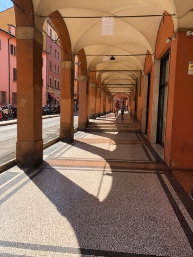
regarding reuse, presented at the beginning of this article. The Italian left was able to make significant modifications to legislation with respect to intervention in the historic center of Bologna in the 1960s and 70s (
Figure 5), when architect Pier Luigi Cervellati carried out one of the first projects under a municipal administration of the Communist Party in Italy, which was received by middle class residents as a threat to their interests, and only part of the initially proposed plan was carried out
| [5] | Cedeño, A. (1998) “Are there national methods for intervening in urban heritage?”. In Magazine Diseño y Sociedad num. 9, winter, 1998. Mexico: UAM Xochimilco. |
[5]
.
Figure 5. Corridor resulting from the “policy of reuse” during restoration of the historic center of Bologna.
From this paradigmatic intervention arose the concept of holistic conservation - reusing heritage architecture as a “container”, for example use palaces for low-income housing or public services such as health and education. Furthermore, legislation resulting from this intervention led to policies favoring architectural reuse and recovery. For example, Italy`s 1978 Law 457 recognized not only the lack of housing but also its poor distribution, as well as gentrification and urban decay, and deemed that recovery of urban heritage – particularly in historic centers - should be prioritized in order to rectify these problems
| [4] | Cedeño, A. (1989) “Italian historic centers”. In Magazine Vivienda vol. 14, num. 2, Jul/Dic, 1998. Mexico: Infonavit. |
[4]
. According to this policy, reuse allowed for satisfying the housing deficit and reconstructing the residential fabric; renovation of urban structures to house public services; and reappropriation of social and collective uses of urban spaces by historically marginalized classes
| [11] | Dezzi, Bardeschi, M. (1981) “Limits and ways of conservation”. In Building reuse and redevelopment in the 1980s. Milan: Franco Angeli Ed. |
[11]
.
Conditions which led to adaptive reuse
Adaptive reuse appears to have originated as a response to destruction of historic buildings erected during the Industrial Revolution. In the United States, such destruction of historic urban centers occurred in the 1960s, leading to significant social movements.
Since the onset of neoliberalism, cities have undergone substantial social changes, including privatization of public spaces, promotion of a purely economic vision of social relations among classes, and elimination of the term “social inclusion” from the vocabulary of government agencies. Recent laws turning back mechanisms of social and economic justice have suppressed many rights and eliminated protection of those who are most vulnerable
| [15] | Gissara, M.; Percoco, M.; Rosmini, E. (2018) Imagined Cities. Reuse and New Forms of Living. Rome: manifestolibri – Sa pienza Università di Roma. |
[15]
.
One approach to making cities more inclusive is to reuse abandoned and under-utilized public heritage property - including barracks, schools, factories, commercial establishments, and empty lots - to materialize the “imagined city”
| [15] | Gissara, M.; Percoco, M.; Rosmini, E. (2018) Imagined Cities. Reuse and New Forms of Living. Rome: manifestolibri – Sa pienza Università di Roma. |
[15]
. Within this framework, adaptive reuse originated, involving both environmental initiatives and financial speculation.
Concern for urban heritage led to the discipline known as urban rehabilitation, which aims to integrate urban-territorial planning into conservation policies, and environmental factors into the study of heritage zones. Unlike restoration, rehabilitation focuses on urban heritage – or “lesser” architecture, and therefore, is not as orthodox as restoration with respect to materials and procedures
| [7] | Cedeño, A. (2015) Urban rehabilitation: Origin methodologies, and technology. Mexico: Trillas Ed. |
[7]
.
Another aspect of urban architecture that must be taken into account is the wealth of industrial heritage which has been abandoned due to its obsolescence and/or high level of contamination. Some efforts to preserve other types of heritage, such as historic heritage, have led to re-location of industrial parks that were polluting or otherwise destroying the site. Thus, abandoned industrial complexes have become available for reuse. This was the case of Porto Marghera in Venice, where large passing ships were destroying the lake bottom - a unique ecosystem formed by a confluence of freshwater and sea water, causing an increase in tides and resulting in sinking of the historic city. The industrial settlement was abandoned and no reuse, has been carried out to date. This raises the question as to what may be done with such abandoned heritage that may not easily be reused due to characteristics related to its structure as well as the materials with which it was built
| [6] | Cedeño, A. (2007) “Venice: The contradictions of economic development in environmental pollution and heritage deterioration”. In Magazine Investigación y Diseño vol. 04. Mexico: UAM. |
[6]
.
As Ronchetta and Trisciuoglio (2008) point out, industrialization is a complex pervasive process involving physical, environmental, technical, economic, cultural, and institutional factors. As most industrial heritage consists of private property, it is typically not subject to the rigid rules of protection generally applied to public property. These authors hold that the correct approach to initiating recovery of industrial heritage is industrial archeology, which studies a territory´s industrial development
| [23] | Ronchetta, Ch. and Trisciuoglio, M. (2008) Designing for Industrial Heritage. Turin, Italia: Celid. |
[23]
.
From an industrial archeology perspective, adaptive reuse allows for repairing and reusing such heritage without having to abide by the rigid regulations applied to traditional historic heritage, thus allowing for greater constructive freedom. There is a need for additional research regarding the relationship between industrial archeology and adaptive reuse to provide a more complete panorama of the potential positive and negative consequences of adaptive reuse for conserving this type of heritage
| [23] | Ronchetta, Ch. and Trisciuoglio, M. (2008) Designing for Industrial Heritage. Turin, Italia: Celid. |
[23]
.
Implementation of adaptive reuse in cities should address current and potential future environmental changes faced by these cities. In the effort to develop sustainable cities, it is important to review the UN 2030 Sustainable Development Goals (SDG), published September 25, 2015
| [18] | United Nations (25/09/2015) UN 2030 Sustainable Development Go. United Nations www.un.org |
[18]
. Goal 11 seeks that cities be inclusive, safe, resilient, and sustainable. This UN document points out that as a result of increasing urbanization, cities – which in 2022 were home to over 50% of the global population of one billion people - now generate 70% of global carbon emissions and are responsible for over 60% of energy use; furthermore, a large number of residents live in poor neighborhoods, 90% of whom breathe air that does not comply with World Health Organization safety standards. These socioenvironmental problems were further aggravated by the COVID pandemic due to inadequate sanitary measures.
The SDG suggest reinforcing urban resilience in the face of climate change, assuring a high urban quality of life without harming the environment, developing functional public transportation networks, and promoting urban governance by the local population
| [18] | United Nations (25/09/2015) UN 2030 Sustainable Development Go. United Nations www.un.org |
[18]
. Unfortunately, the UN SDG document does not offer concrete proposals for achieving these goals.
The other SDG address achieving an end to poverty and hunger, health and well-being, quality education, clean water and sanitation, clean affordable energy, decent jobs and economic growth, reducing inequality, peace, justice, strong institutions, and alliances to achieve these goals. All of these goals should be incorporated into sustainable cities of the future
| [18] | United Nations (25/09/2015) UN 2030 Sustainable Development Go. United Nations www.un.org |
[18]
.
Technological advances in recent years have been fundamental for adequate reuse of heritage architecture, leading to improvement of well-being of those who inhabit or otherwise use this heritage. For example, humidity - previously a great obstacle to achieving comfortable spaces – has been reduced in many historic buildings, thanks to techniques such as waterproofing of foundations and walls with novel chemical substances or procedures of an electrical nature, industrially fabricated bathrooms, and improvement of artificial heating and cooling systems. Such construction techniques allow for achieving historic architecture with a comfort level equivalent to that of modern architecture. As heritage architecture was generally made to last for centuries, it is by definition sustainable architecture. A goal of adaptive reuse is to achieve comfort while reducing energy consumption of historic buildings.
For it, Liliane Wong discusses Host Buildings, which consist of exterior structures – or “wrappers” - of diverse types which are transformed into new constructions to be used for new purposes. The suitability of these buildings to being used for a new purpose
“depends on many specific and individual factors: their condition, their potential to sustain additional load, their spatial fit with the demands of a new use, their memory, [and] their placement in context” | [26] | Wong, L. (2017) Adaptative REUSE. Extending the Lives of Buildings. Berlin, Germany: BIRKHÄUSER BASEL. SI. |
[26]
. Wong provides the following classification of host buildings, for which their attributes determine the type of intervention required for reuse:
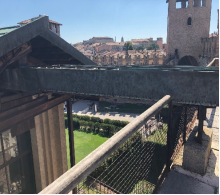
1) Whole building host: The most common type of host structure consists of an entire intact building for which its use may be modified through intervention into the interior and/or exterior (Nieto, 2022). For example, Carlo Scarpa transformed a previously altered medieval castle, into the Castelvecchio Museum through renovation, subtraction, and addition
| [26] | Wong, L. (2017) Adaptative REUSE. Extending the Lives of Buildings. Berlin, Germany: BIRKHÄUSER BASEL. SI. |
[26]
.
Figure 6. View of the reuse carried out by Carlo Scarpa at the Castelvecchio Museum.
2) Shell host: All parts of this type of host building may be modified except for the building envelope. Thus, it acts as a shell to contain a variety of new activities. Shell hosts are often heritage buildings with an exterior which has been designated as protected
.
3) Semi-ruin host: While the building envelope and part of the structure of a whole building host are relatively intact, semi-ruin buildings have an incomplete structure, infrastructure, or both, requiring restoration before carrying out necessary actions to modify their use. Intervention into semi-ruin hosts may involve interior insertions as well as additions of new structure, walls, and/or floors
.
4) Fragmented host: Such highly incomplete, uninhabitable buildings are extreme cases of semi-ruins. Adaptive reuse is approached almost as if it were a new work, with the addition being justified according to the historic significance of the fragment as well as economic considerations
.
5) Relic host: Such structures are not fit for transformation, but rather serve as catalysts for new constructions, recalling a historical event or period
| [26] | Wong, L. (2017) Adaptative REUSE. Extending the Lives of Buildings. Berlin, Germany: BIRKHÄUSER BASEL. SI. |
[26]
.
6) Group hosts: In this case, adaptive reuse is carried out on a set of related buildings, such as a building complex or multiple elements of an overall urban environment, typically to commemorate a historic era, event, or community. This is the case of heritage sites protected by UNESCO. This larger scale of adaptive reuse generates a series of technical difficulties, involving
“the condition of individual structures, the physical relationship among them, their individual place in history, and their collective interrelations” .
In these cases, it would be advisable to address their repair through rehabilitation, although Wong does not contemplate this option.
Proposed guidelines for reuse
Pietro Carlo Pellegrini (2018)
| [20] | Pellegrini, P. C. (2018) Architectural Reuse Manual. Palermo, Italy: Dario Flaccovio Ed. |
[20]
in his text “Manual of Architectural Reuse” proposes criteria to be followed upon restoring or reusing a building. He affirms that “it is necessary to correctly interpret the typology, function, structure, materials, and constructive modalities” of a building, and that “knowledge of each of the components of a construction is fundamental to correctly establishing new uses for existing structures,” taking into account functional and aesthetic characteristics, and using physically and chemically compatible materials” (p. 137). He recommends carrying out an architectural survey, and graphically illustrating the details of the construction to critically analyze its spatial characteristics and historic evolution so that the restoration architect may preserve the building`s original elements as faithfully as possible
| [20] | Pellegrini, P. C. (2018) Architectural Reuse Manual. Palermo, Italy: Dario Flaccovio Ed. |
[20]
. This author states that such intervention should be carried out by a restorer, and that not just any architect – despite being a skilled designer – is qualified to carry out such work. However, in the event that an architect who lacks restoration experience should assume the responsibility of restoration or adaptive reuse, he or she should follow Pellegrini´s guidelines in order to avoid irreversibly damaging heritage architecture.
The question arises as to whether restorers or others undertaking restoration are prepared to assume the challenge of incorporating environmentally friendly materials and techniques. Pellegrini presents the successful example of restoration of the Roman Theater of Sagunto, Spain under the direction of Giorgio Grassi, stating, “Considered to be the maximum [show of] respect for that which exists, conservation should go hand in hand with innovation”
| [20] | Pellegrini, P. C. (2018) Architectural Reuse Manual. Palermo, Italy: Dario Flaccovio Ed. |
[20]
. He adds that recovery of historic architecture should not be a mechanism to crystallize a structure, but rather the restorer should know how to positively respect transformation by conserving the structure´s essence.





 Share This Article
 Twitter
 Linked In
 Facebook
 Copy
Copy Download